

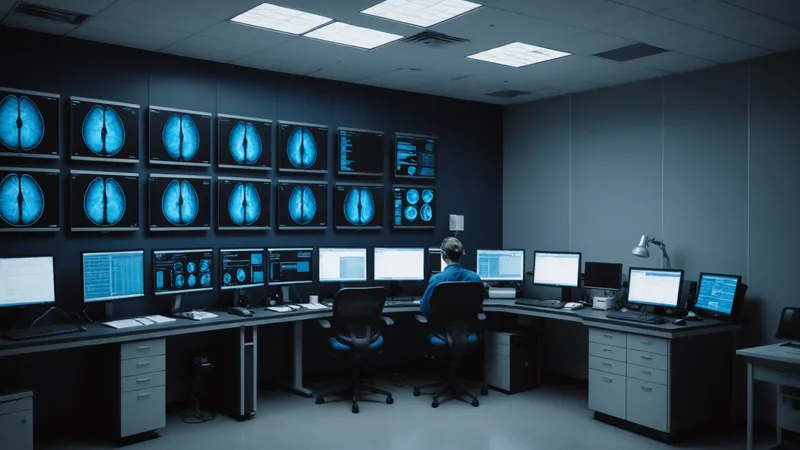
Before we built Histolyx, I spent eighteen months talking with radiologists at imaging centers across San Diego County. The number that kept coming up wasn't a metric from a published paper — it was fifty. Fifty cases per shift was where people started describing their work differently. Below that threshold, they talked about reads. Above it, they talked about getting through the queue.
That shift in language matters. It's not that radiologists become less capable at case 51. But the cognitive environment changes in ways that are worth understanding if you run an imaging center or care about diagnostic quality at scale.
The Attention Economy of a Radiology Shift
Radiologists operate under a particular kind of sustained attention pressure that's different from most other high-stakes cognitive work. Unlike a surgeon who completes one procedure before starting another, a radiologist on a busy shift opens and closes dozens of distinct cases — each requiring them to reset context, load patient history, assess the study, and dictate or generate a report. Multiply that context-switching overhead by fifty or more, and you get a shift structure that's genuinely demanding in ways that aggregate numbers don't capture.
The published literature on vigilance decrements in visual search tasks — the class of work that includes scan review — consistently shows that error rates begin climbing after sustained periods of search without breaks. In perceptual tasks specifically, the second half of a long shift tends to show measurably higher miss rates for subtle findings than the first half. This isn't a character flaw; it's how sustained attention works.
What matters practically is that the errors aren't random. Miss patterns in high-volume reads tend to cluster around two failure modes: subtle findings that require active search (small pulmonary nodules in complex chest CTs, calcification patterns in dense breast tissue) and findings that are unusual enough to require mental effort to classify correctly (unexpected lymphadenopathy, incidental findings outside the primary indication).
Worklist Structure and Where Bottlenecks Actually Form
When imaging center administrators talk about throughput problems, they usually mean something specific: studies sitting in queue for more than a target turnaround time, often four to six hours for routine outpatient reads. But the bottleneck isn't always where it appears.
In a typical worklist-driven workflow, a radiologist's pace through the queue is uneven. Complex multiplanar reconstructions — a contrast-enhanced chest CT with 400 axial slices, for instance — take significantly longer per study than a simple two-view chest X-ray. Worklist ordering algorithms that don't account for study complexity can create situations where a radiologist who is nominally "keeping up" is actually burning disproportionate time on a cluster of complex studies that arrived mid-shift, creating a downstream queue backup.
The second bottleneck is prior comparison. Serial imaging — chest CTs with a six-month prior, mammograms with annual comparisons — requires loading the prior study, navigating to comparable slices, and mentally registering what changed. This is time-consuming, and in a high-volume shift, it's the step that gets compressed first. A radiologist under pressure may do a qualitative "looks stable" comparison rather than a systematic measurement comparison. This is where change detection matters most.
What the 50-Case Threshold Really Represents
The fifty-case number is, to be clear, not a universal clinical threshold. Different imaging centers, different modality mixes, and different study complexities mean the real tipping point varies. A fifty-case shift of screening mammograms is cognitively different from fifty-case shift that includes fifteen chest CT screenings with extensive prior comparison requirements.
What the threshold represents is a useful heuristic for when cognitive support tools become qualitatively valuable rather than just marginally convenient. A radiologist reading twenty cases on a relaxed morning shift who has a pre-reader highlighting findings gets modest value — the time savings and cognitive offload are real but not transformative. A radiologist in hour seven of a fifty-case shift who opens a complex chest CT and sees three regions already annotated with nodule measurements gets something meaningfully different: a cognitive anchor that lets them verify rather than hunt.
That distinction — verify versus hunt — is the core of how we think about what Histolyx does. We're not arguing that unaided radiologists miss things catastrophically. We're saying that the conditions under which misses become more likely are predictable and addressable.
The Cumulative Load Problem
One pattern that came up repeatedly in our early conversations was what radiologists described informally as "drift" — a progressive adjustment of internal thresholds over the course of a heavy shift. A nodule that would have triggered a "recommend follow-up" recommendation at case five gets a "probably nothing" read at case forty-five, not because the radiologist's knowledge has changed, but because the mental cost of a recommendation (additional report text, potential callback, possible patient anxiety) accumulates in the context of a shift that's already running long.
This isn't conscious. The radiologists who described this to us weren't confessing to negligence — they were trying to explain something they'd observed about their own cognition under load. And it's worth taking seriously, because it represents a systematic bias toward under-reporting in high-volume conditions, precisely when the imaging center most needs accurate reports.
One radiologist at a growing imaging center in the North County San Diego area described a shift where she read thirty-eight chest CTs in a single session because of staff illness coverage. "By case thirty," she said, "I was still reading accurately. But I was making faster decisions. When I went back the next day and looked at my reports, the recommendations on the last ten cases were shorter and less specific than my usual work. Nothing I'd call a miss, but a different kind of read."
How Pre-Reading Changes the Cognitive Load Equation
The promise of a pre-reader in this context is not that it catches everything the radiologist might miss. That framing is both wrong and counterproductive — it overstates AI capability and undersells the radiologist's role. What a well-implemented pre-reader does is restructure the cognitive task.
When Histolyx pre-reads a chest CT before it reaches the worklist, the radiologist opening that study starts from a different position. Regions of interest are already marked. Nodule measurements are already computed. Change from the prior study is already flagged. The radiologist's task becomes confirmatory rather than investigative. They're reviewing and adjudicating findings rather than generating them from scratch.
This restructuring is meaningful specifically at high volume. In a twenty-case shift, the difference between investigative and confirmatory reading might be small — a radiologist at peak attention is good at both. In a fifty-case shift, confirmatory reading in the back half of the day maintains quality more reliably than investigative reading, because the cognitive load of generating findings from scratch compounds with fatigue in ways that reviewing pre-marked findings does not.
We're not saying pre-reading eliminates the need for experienced radiologists or that it catches everything a fatigued radiologist might miss. The radiologist is always the clinical authority. What we're saying is that restructuring the reading task from generation to verification is a meaningful quality safeguard in the specific conditions — high volume, long shifts, complex studies with prior comparisons — where the existing evidence suggests degraded performance is most likely.
Practical Implications for Imaging Center Administrators
If you're managing an imaging center that regularly schedules radiologists for fifty-plus case shifts, the questions worth asking are structural. Are your worklists complexity-weighted, or do they feed studies in arrival order regardless of study type? Do you have systematic change detection support for serial imaging, or is prior comparison a manual step each radiologist handles individually? What does your report quality look like in the second half of heavy shifts versus the first?
That last question is harder to answer than it sounds. Most imaging centers don't have the tooling to systematically compare report depth or recommendation specificity across shift timing. It's worth thinking about whether the data you'd need even exists in your current PACS and RIS configuration.
Workflow tool selection, whether pre-reading software or worklist management, should be evaluated against the specific conditions where quality pressure is highest — not against average-shift performance where a competent radiologist does fine with or without support. The case for any cognitive support tool in radiology is strongest exactly where the work is hardest.